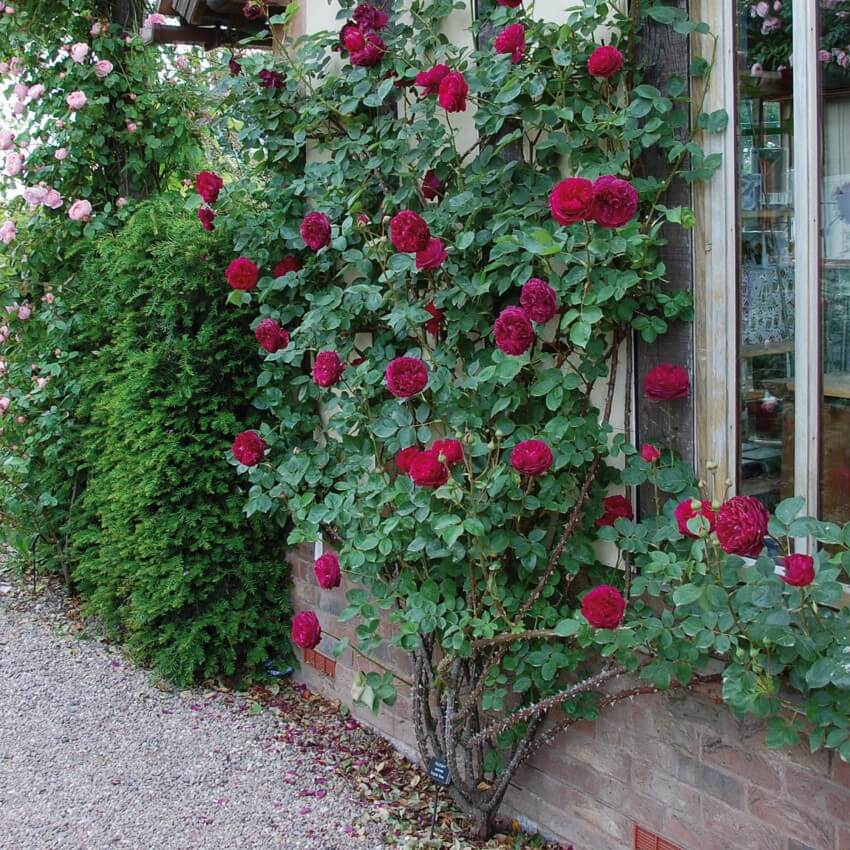


English floribunda rose bred by David Austin
Falstaff
Falstaff
Find out why → Close ↑
Bare-root roses are lifted only after they enter dormancy and the shoots have fully matured and hardened. Lifting them too early can stress the plants and leave young growth insufficiently mature.
We do not force the season simply to ship earlier. We wait for the right point in the plant’s natural cycle, so you receive a strong, well-matured rose ready for planting and the season ahead.
What about colder regions and winter frost?
Waiting until the shoots have fully matured helps the plants enter winter better prepared for low temperatures.
Famous Roses provides a 180-day establishment guarantee for bare-root roses.
Couldn't load pickup availability
Sign up for restock notifications
Introduce rich colour and powerful perfume with Falstaff, a David Austin English shrub rose producing large, shallowly cupped blooms in dark crimson that gradually mature towards sumptuous purple. Reaching approximately 125 cm in height and 90 cm in width, it combines repeat flowering, numerous interfolded petals and a commanding Old Rose fragrance.
Choose it if you want a dramatic English rose whose deeply coloured flowers create guest admiration in borders, dedicated rose beds and richly scented garden planting.
Full Description →
Full Description:
Every garden has its quieter characters, but Falstaff was never created for a minor role. From the moment its first dark-crimson flower opens, nearby plants seem to become part of the supporting cast and the border begins to feel like a stage prepared for its entrance.
David Austin named this rose after Shakespeare’s unforgettable Falstaff, the spirited companion of Prince Hal. The name suits a variety with such warmth, confidence and unmistakable presence: generous in flower, rich in fragrance and impossible to overlook once it has taken its place in the garden.
Its large, shallowly cupped blooms open in intense dark crimson before gradually developing sumptuous purple tones. Numerous petals fold and interweave at the centre, creating a glowing depth of colour within the more open circle of outer petals.
The perfume is powerful and unmistakably traditional, carrying the rich character of an Old Rose. Plant Falstaff near a terrace, entrance or frequently used path, where its fragrance can become part of every walk through the garden.
Flowering returns in generous flushes from late spring until the first frosts. The plant develops into a medium-sized English shrub approximately 125 cm tall and 90 cm wide, giving it enough presence for the middle or back of a border without requiring the space of a large climbing rose.
Falstaff is the rose to choose when pale colours feel too restrained and an ordinary red is not enough. Its crimson-to-purple flowers and deeply evocative perfume create a garden scene with all the drama, romance and character of a Shakespearean performance.
Show less →Characteristics →
Characteristics:
Official name: Falstaff®
Variety code: Ausverse
Type: English shrub rose
Breeder: David Austin
Introduced: 1999
Colour: Dark crimson maturing towards rich purple
Flower form: Large, very full and shallowly cupped
Petal arrangement: Numerous petals interfolding at the centre
Bloom size: Large, approximately 9–12 cm under suitable conditions
Fragrance: Strong
Fragrance character: Powerful traditional Old Rose
Flowering: Repeat flowering from late spring until the first frosts
Height at maturity: Approximately 125 cm
Width at maturity: Approximately 90 cm
Growth habit: Upright, substantial and bushy
Exposure: Full sun
Aspect: Suitable for east-, south- or west-facing positions
Planting distance: Approximately 80–90 cm
Use: Rose beds, mixed borders, cottage gardens, fragrant planting and specimen positions
Delivery format: Quality 1+ premium, second-year rose bush grafted onto a vigorous rootstock
Show less →Frequently Asked Questions →
Frequently Asked Questions:
What colour are Falstaff’s flowers?
The blooms open in a rich, dark crimson and gradually develop deeper purple tones as they mature. Cooler conditions can make the colouring appear especially intense.
Why do the flowers appear to glow at the centre?
Numerous petals fold and interweave within the shallow cup, concentrating colour and shadow at the centre while the outer petals form a more open frame.
How large are Falstaff’s flowers?
Falstaff produces large blooms, generally within the large-flowered David Austin category of approximately 9–12 cm at their prime, although size varies with climate and growing conditions.
How strong is the fragrance?
Falstaff has a powerful traditional Old Rose fragrance. It is an excellent choice for planting near a path, terrace, doorway or seating area.
Does Falstaff flower repeatedly?
Yes. It produces successive flowering flushes from late spring until the first frosts rather than offering only one seasonal display.
How tall and wide does Falstaff grow?
An established plant generally reaches approximately 125 cm in height and 90 cm in width when pruned annually.
Where should I plant Falstaff?
Choose a sunny position with fertile, well-drained soil. Its substantial growth makes it suitable for the middle or back of a mixed border or for a prominent place in a dedicated rose bed.
Can Falstaff be planted as a specimen rose?
Yes. Its strong colour, large flowers and upright presence give it enough visual impact to stand alone as a focal point.
Can several Falstaff roses be planted together?
Yes. A group of three can create a concentrated display of dark crimson and purple, while also intensifying the fragrance around the planting area.
How far apart should the roses be planted?
Allow approximately 80–90 cm between plants so each shrub has room to reach its mature width while retaining suitable airflow.
Is Falstaff suitable for a smaller garden?
Yes, provided there is room for a shrub approximately 125 × 90 cm. In a compact garden, one plant can provide a strong focal point without requiring climbing support.
Can Falstaff be grown in a container?
It can be grown in a very large, deep container with excellent drainage, although its substantial shrub habit is generally best suited to planting in the ground.
Which plants combine well with Falstaff?
Pale pink roses, white foxgloves, lavender, nepeta and silver foliage soften its dramatic colouring. Apricot or golden flowers create a warmer and more theatrical contrast.
Why was the rose named Falstaff?
David Austin named it after Shakespeare’s famous character, the lively and memorable companion of Prince Hal. The rose’s bold presence and generous character make the name particularly fitting.
What makes Falstaff different from other dark red roses?
It combines dark-crimson flowers that mature towards purple with a distinctive shallow-cupped form, densely interfolded petals and a powerful Old Rose fragrance.
How should Falstaff be pruned?
Prune in late winter or early spring by removing dead, damaged and crossing growth, then reduce the remaining stems to maintain an open, balanced shrub and encourage strong new flowering shoots.
What does the rose look like on delivery?
Its appearance depends on the delivery season and natural stage of growth. For examples and explanations, see What roses look like on delivery →.
What should I do after planting?
Plant it in a sunny position, water thoroughly and keep the soil evenly moist while the roots establish. For detailed instructions, visit our complete planting guide →.
Share