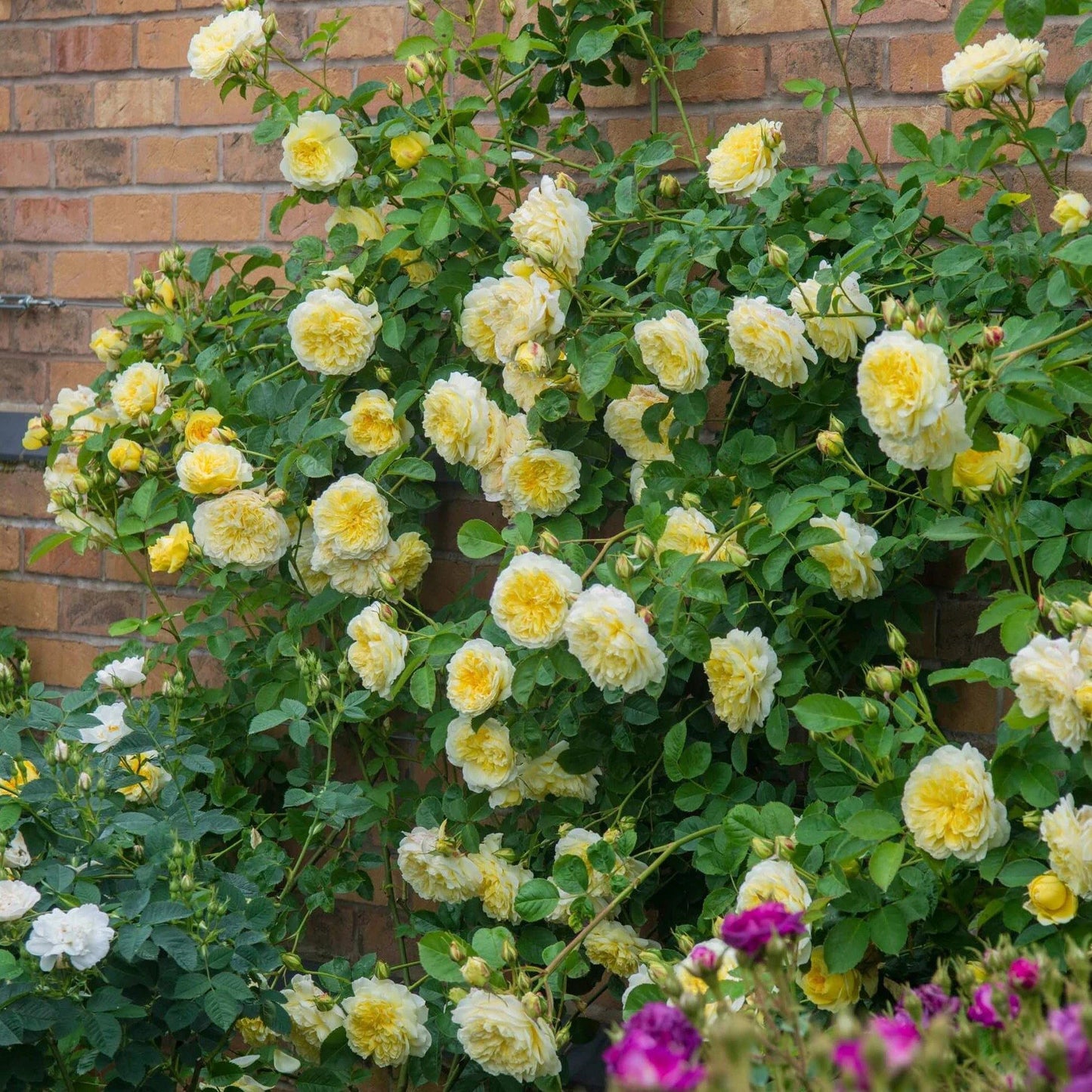


Climbing Rose • Created by David Austin • England
The Pilgrim
The Pilgrim
Find out why → Close ↑
Bare-root roses are available to order now, with deliveries starting on 26 October. Close ↑
Bare-root roses are lifted only after they enter dormancy and the shoots have fully matured and hardened. Lifting them too early can stress the plants and leave young growth insufficiently mature.
We do not force the season simply to ship earlier. We wait for the right point in the plant’s natural cycle, so you receive a strong, well-matured rose ready for planting and the season ahead.
What about colder regions and winter frost?
Waiting until the shoots have fully matured helps the plants enter winter better prepared for low temperatures.
Famous Roses provides a 180-day establishment guarantee for bare-root roses.
Couldn't load pickup availability
The Pilgrim® is a David Austin climbing rose with soft yellow, many-petalled flowers, a medium Tea-and-myrrh fragrance and reliable repeat flowering. It grows quickly to about 3.75 m while continuing to flower and carry foliage lower down the plant, making it especially useful for walls, arches, doorways, pillars and large fences.
Choose it if you want a luminous yellow climber that brings fragrance, height and the romantic character of a classic David Austin rose to a vertical garden feature.
Full description →
Full description:
The Pilgrim® brings a soft, glowing yellow to the garden rather than a harsh or brassy colour. Its buds open into many-petalled cups that gradually become large, flat rosettes, with the petals paling prettily towards the edges.
Created by David Austin and introduced in 1991, it takes its name from the pilgrims in Geoffrey Chaucer’s Canterbury Tales. The name suits a rose that steadily makes its way upwards while continuing to reward the eye closer to ground level.
The fragrance is medium in strength and balances Tea and myrrh notes. It is noticeable enough to add atmosphere around an arch, doorway or seating area without overwhelming the rest of the planting.
As a climber, The Pilgrim® reaches about 3.75 m under David Austin conditions. It grows quickly, yet keeps producing flowers and foliage lower down the plant, helping walls and supports feel covered rather than bare at the base.
It repeat-flowers from late spring into the colder part of the year and can be grown in full sun or partial shade. The RHS has also recognised The Pilgrim® with the Award of Garden Merit.
Show less →Characteristics →
Characteristics:
Type: Climbing Rose
Breeder: David Austin
Varietal name: Auswalker
Introduced: 1991
Colour: Soft yellow, paling towards the outer petals
Flower: Many-petalled cups opening into large, flat rosettes
Fragrance: Medium, Tea and myrrh
Flowering: Repeat flowering
Height at maturity: Approximately 3.75 m
Growth habit: Vigorous climbing growth with good lower-level flowering and foliage
Exposure: Full sun or partial shade
Use: Walls, fences, arches, doorways, obelisks, pillars and other substantial supports
Award: RHS Award of Garden Merit
Named after: The pilgrims in Geoffrey Chaucer’s Canterbury Tales
Delivery format: Potted rose or bare-root rose, depending on season and availability
Frequently asked questions →
Does The Pilgrim® repeat flower?
Yes. It produces repeated flushes from late spring onwards.
What does The Pilgrim® smell like?
Its medium-strength fragrance combines Tea and myrrh in a balanced, distinctive scent.
How tall does it grow?
David Austin lists it as a medium climber reaching approximately 3.75 m.
Can it grow in partial shade?
Yes. It can be grown in full sun or partial shade.
Where is it best planted?
Use it on walls, fences, arches, doorways, pillars or other structures where its climbing habit can be trained and appreciated.
What does the rose look like on delivery?
Its appearance depends on the delivery season and natural stage of growth. See What roses look like on delivery →.
What should I do after planting?
Water thoroughly, keep the soil lightly moist while roots establish and begin tying the main shoots to a sturdy support. See the planting guide →.
Share