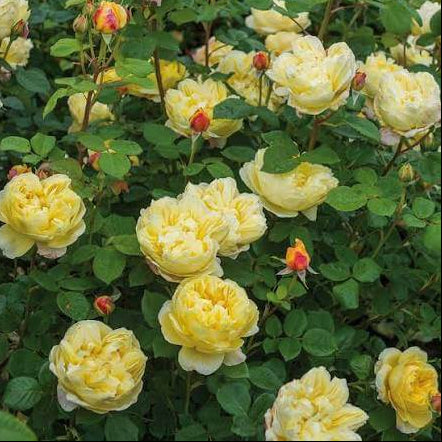


Floribunda Rose • Created by David Austin • England
Charles Darwin
Charles Darwin
Find out why → Close ↑
Bare-root roses are available to order now, with deliveries starting on 26 October. Close ↑
Bare-root roses are lifted only after they enter dormancy and the shoots have fully matured and hardened. Lifting them too early can stress the plants and leave young growth insufficiently mature.
We do not force the season simply to ship earlier. We wait for the right point in the plant’s natural cycle, so you receive a strong, well-matured rose ready for planting and the season ahead.
What about colder regions and winter frost?
Waiting until the shoots have fully matured helps the plants enter winter better prepared for low temperatures.
Famous Roses provides a 180-day establishment guarantee for bare-root roses.
Couldn't load pickup availability
Discover the distinctive warmth of Charles Darwin, a David Austin English Shrub Rose with large, very full yellow flowers that can deepen towards unusual mustard tones. Strongly fragrant with Tea and fresh lemon notes, it forms a broad, spreading shrub approximately 110 cm high and 140 cm wide, bringing quiet luxury to borders, rose beds and generous containers.
Choose it if you want a substantial English Rose with an unusual yellow palette, richly petalled flowers and a strong fragrance, and you have enough room to allow its naturally broad habit to develop.
Full description →
Full description:
Charles Darwin was a man who looked closely at the natural world and discovered that its greatest stories were often hidden in variation. The rose that carries his name seems particularly appropriate: its beauty is not fixed in one perfect shade or one precise flower shape. It changes as you watch it.
Bred by David Austin and introduced in 2003, Charles Darwin produces some of the most distinctive yellow flowers among the English Roses. The buds open into large, exceptionally full and rounded blooms, packed with petals. As the flowers mature, their tightly enclosed shape gradually relaxes into a broad, shallow cup.
Colour has similar complexity. Rather than a simple bright yellow, Charles Darwin moves through warmer, earthier shades and can develop the mustard-yellow tones for which the variety is particularly known. Growing conditions and the stage of the flower influence the precise colour, so different blooms can show subtly different expressions at the same time.
Then there is the fragrance. Strong and distinctive, it can move between the softness of a floral Tea scent and the clarity of fresh lemon. The contrast suits the flower perfectly: rich and traditional in appearance, yet unexpectedly fresh when you lean closer.
The plant itself has presence. Charles Darwin develops into a sturdy, broad and spreading shrub, reaching approximately 110 cm in height and 140 cm in width under typical UK conditions. It therefore works particularly well where it has room to develop naturally rather than being confined to a narrow planting space.
Use it towards the middle or back of a mixed border, plant several together for a substantial flowering group, or allow it to form an informal low rose hedge. It can also be grown in a generously sized container and, unusually usefully for a rose of this character, David Austin recommends it for both full sun and partial shade.
Charles Darwin belongs to an earlier generation of David Austin English Roses and is now regarded by the breeder as one of its historical varieties. Newer Austin introductions have surpassed it in disease resistance and the vigour of their repeat flowering, but Charles Darwin continues to be valued for qualities that are entirely its own.
Perhaps that is the most fitting connection with its name. Charles Darwin is not a rose about uniform perfection. It is a rose about variation: rounded flowers becoming open cups, yellow developing into mustard, and a Tea fragrance suddenly revealing fresh lemon. Look closely, and there is always something more to discover.
Show less →Characteristics →
Characteristics:
Official name: Charles Darwin®
Variety code: AUSpeet
Type: English Shrub Rose
Breeder: David Austin
Country of origin: United Kingdom
Introduced: 2003
Named after: Charles Darwin, British naturalist born in Shrewsbury, Shropshire
Colour: Warm yellow, sometimes developing distinctive mustard-yellow tones
Flower form: Very full and rounded at first, opening into broad shallow cups
Flower size: Large, approximately 9–12 cm
Fragrance: Strong
Fragrance character: Soft floral Tea to fresh lemon
Flowering: Repeat flowering in flushes through the season
Height at maturity: Approximately 110 cm
Width at maturity: Approximately 140 cm
Growth habit: Sturdy, broad and spreading
Exposure: Full sun or partial shade
Soil: Suitable for a wide range of soil types when well prepared and adequately drained
Use: Mixed borders, rose beds, informal hedges and large containers
Delivery format: Quality 1+ premium, second-year rose bush grafted onto a vigorous rootstock
Show less →Frequently asked questions →
Frequently asked questions:
What colour is Charles Darwin?
Charles Darwin is a warm yellow rose, but its colour is more complex than a typical clear yellow. The flowers can develop distinctive mustard-yellow tones, with the precise shade changing according to flower maturity and growing conditions.
What shape are the flowers?
The flowers begin very full and rounded, with many petals enclosed within the bloom. As they mature, they gradually open into broad, shallow cups.
How large are the flowers?
David Austin classifies Charles Darwin as a large-flowered English Rose, with blooms generally around 9–12 cm across at their prime.
Is Charles Darwin strongly fragrant?
Yes. David Austin classifies its fragrance as strong, making scent one of the principal reasons to choose this variety.
What does Charles Darwin smell like?
Its fragrance can vary between a soft floral Tea character and a much fresher pure lemon note. This contrast gives the perfume a particularly distinctive personality.
Does Charles Darwin repeat flower?
Yes. Charles Darwin is repeat flowering and produces additional flushes after its first display. However, David Austin notes that its repeat flowering is not as vigorous as that of the breeder's more recent varieties.
How large does Charles Darwin grow?
David Austin's UK specification gives approximately 110 cm in height and 140 cm in width for an established shrub, showing that this rose grows noticeably wider than it does tall.
Does Charles Darwin need plenty of space?
Yes. Its broad, spreading habit is an important consideration when choosing a planting position. Allowing approximately 140 cm of mature width lets the shrub develop its natural shape without crowding neighbouring plants.
Can Charles Darwin grow in partial shade?
Yes. David Austin specifically recommends Charles Darwin for partial shade as well as full sun, making it useful for positions that do not receive uninterrupted sunshine throughout the day.
Is Charles Darwin disease resistant?
Charles Darwin is an older David Austin variety, introduced in 2003. David Austin now explains that it does not reach the same disease-resistance standards as its more recent introductions. Good air circulation, appropriate watering and attentive rose care are therefore particularly worthwhile.
Is Charles Darwin a good choice for a beginner?
It can be very rewarding if its unusual colour and strong fragrance are your priorities, but gardeners wanting the strongest possible modern disease resistance may prefer a more recent David Austin introduction.
Can Charles Darwin be grown in a container?
Yes. David Austin lists it as suitable for pots and containers. Because the mature shrub is broad and substantial, choose a large, deep container and provide consistent watering and feeding.
Can Charles Darwin be used as a rose hedge?
Yes. Its broad, spreading growth makes it suitable for an informal flowering hedge, where several plants can develop into a substantial mass of yellow flowers.
Which plants combine well with Charles Darwin?
Its warm yellow and mustard tones work particularly well with blue and violet perennials such as nepeta, salvia and hardy geraniums. Deep burgundy foliage can create a richer contrast, while cream and white flowers produce a softer scheme.
Why was the rose named Charles Darwin?
David Austin named the variety after the British naturalist Charles Darwin, who was born in Shrewsbury, Shropshire, not far from the David Austin nursery.
What makes Charles Darwin different from other yellow English Roses?
Its combination of unusually warm mustard-yellow colouring, exceptionally full flowers, broad spreading growth and strong Tea-to-lemon fragrance gives Charles Darwin a character quite different from softer or brighter yellow varieties.
What does the rose look like on delivery?
Its appearance depends on the delivery season and natural stage of growth. For examples and explanations, see What roses look like on delivery →.
What should I do after planting?
Water thoroughly after planting and keep the soil evenly moist while the roots establish. For detailed instructions, visit our complete planting guide →.
Share